Auditing Your Own Repository Without Being Treated Like an Attacker: DevSecOps on bf16.ai
Automated cyber classifiers routinely sever defensive SAST triage mid-stream when generating SQLi, SSRF, or JWT regression tests. Build a zero-retention two-pass security remediation pipeline on bf16.ai.
TL;DR · AppSec Engineering Summary
- The Defensive Paradox: Output classifiers on frontier APIs cannot reliably distinguish an engineer writing a local Vitest regression spec for their own legacy DAO from an external attacker — and cut real SQLi/SSRF/JWT triage streams off mid-response with
finish_reason: "content_filter".- Two-Pass Tiered Architecture on bf16.ai: Filter noisy Semgrep/CodeQL alerts first on
deepseek/deepseek-v4.1-flash-abliterated($0.30 / $0.05 / $1.20), then escalate confirmed reachable sinks tozai-org/glm-5.3-abliteratedFlagship ($1.40 / $0.30 / $4.40) for strict JSON regression tests + unified patches.- Zero-Prompt Retention (
ZDR): bf16.ai stores0 bytesof your proprietary repository diffs on disk while matching official vendor API pricing.
1. Why Frontier Cyber Safeguards Break Defensive CI Pipelines Mid-Stream
Static Application Security Testing (SAST) tools like Semgrep and CodeQL are indispensable, yet every AppSec engineer knows their core flaw: a large share of raw static alerts are unexploitable noise. A string interpolation flagged inside an internal migration script or behind a strict Zod z.enum() validator is not a production SQL injection vulnerability.
Using an LLM in CI to trace source-to-sink reachability — and automatically generate a failing Vitest unit test plus a parameterized Drizzle/Prisma patch — should be the textbook DevSecOps workflow of 2026. Instead, teams hit mid-stream classifier amputations. Even when the model starts answering, a secondary output monitor sees an escaped SQL quote or SSRF loopback test vector inside the generated unit test and severs the SSE stream at token 64:
[ci:sast-triage] Alert #418 -> semgrep.javascript.express.db.sequelize-raw-sql
[ci:sast-triage] Requesting source-to-sink reachability + Vitest regression test...
[upstream:frontier-api] HTTP 200 (stream truncated at token 64)
  finish_reason: "content_filter"
  error: "Output halted by automated cyber-risk safeguard: response appeared to construct a SQL injection proof-of-concept payload."
[ci:sast-triage] ERROR: Unexpected EOF in JSON stream. PR #892 security check marked INCONCLUSIVE.
2. Two-Pass Source-to-Sink Remediation on bf16.ai (Zero Lectures, Zero Retention)
When you audit first-party source code you own, you need two non-negotiable guarantees from your inference layer: unfiltered technical precision and Zero-Prompt Retention (ZDR) so unreleased proprietary diffs are never logged or recycled into training corpora.
On bf16.ai, you can run a two-stage pipeline across our 1M-context abliterated models:
- Pass 1 — Bulk False-Positive Filtering (
deepseek/deepseek-v4.1-flash-abliterated): Feeds up to100,000tokens of AST context, middleware chains, and Zod schemas into DeepSeek V4.1 Flash ($0.30/1Minput,$0.05/1Mcached) and discards static warnings whose sinks are unreachable. - Pass 2 — Regression Spec & Unified Diff (
zai-org/glm-5.3-abliterated): Escalates only confirmed reachable sinks to GLM-5.3 Flagship (Abliterated). Usingresponse_format: { type: "json_schema", strict: true }, it emits the exact trace, a runnable local Vitest regression test, and a minimalgit applypatch without moralizing caveats.
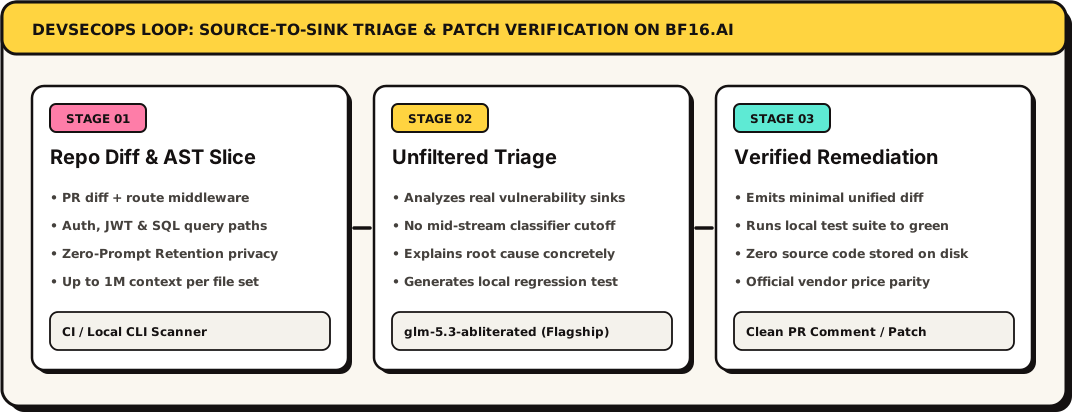
▲ DevSecOps Remediation Loop: PR diff + AST context routed through bf16.ai ZDR endpoints to produce verified local regression tests and patches.
3. Production TypeScript Triage Engine & GitHub Actions Workflow
Below is the exact TypeScript helper using bf16.ai's strict json_schema mode on zai-org/glm-5.3-abliterated. Because orthogonal weight abliteration preserves grammar state machines intact, every field (exploitable, sink_trace, vitest_regression_spec, unified_patch) parses deterministically on the first pass:
import OpenAI from 'openai';

const bf16 = new OpenAI({
  baseURL: 'https://api.bf16.ai/v1',
  apiKey: process.env.BF16_SEC_AUDIT_KEY,
});

export async function auditDiffAndEmitPatch(gitDiff: string, routeContext: string) {
  // Pass 2 Deep Remediation on GLM-5.3 Flagship (Abliterated)
  const response = await bf16.chat.completions.create({
    model: 'zai-org/glm-5.3-abliterated',
    temperature: 0.1,
    response_format: {
      type: 'json_schema',
      json_schema: {
        name: 'sast_remediation_bundle',
        strict: true,
        schema: {
          type: 'object',
          additionalProperties: false,
          required: ['exploitable', 'sink_trace', 'vitest_regression_spec', 'unified_patch'],
          properties: {
            exploitable: { type: 'boolean' },
            sink_trace: { type: 'string' },
            vitest_regression_spec: { type: 'string' },
            unified_patch: { type: 'string' },
          },
        },
      },
    },
    messages: [
      {
        role: 'system',
        content:
          'You are an application security remediation engine auditing first-party repository code. ' +
          'Determine whether user-controlled input reaches the sink unparameterized. If exploitable, ' +
          'emit a local Vitest regression test and a minimal unified diff fixing the sink.',
      },
      { role: 'user', content: `## Route Context\n${routeContext}\n\n## PR Diff\n${gitDiff}` },
    ],
  });

  return JSON.parse(response.choices[0]?.message?.content ?? '{}');
}
Wire the script into GitHub Actions or GitLab CI so every pull request verifies that the generated regression test fails before the patch and passes after git apply. Notice on bf16.ai/pricing how both Pass 1 and Pass 2 endpoints align transparently with official vendor API rates — no monthly seat fees per developer:
# .github/workflows/bf16-sast-remediation.yml
name: PR Security Triage (bf16.ai ZDR)
on: [pull_request]

jobs:
  sast_verify:
    runs-on: ubuntu-latest
    steps:
      - uses: actions/checkout@v4
        with:
          fetch-depth: 0
      - name: Run Semgrep & Triage Reachable Sinks via bf16.ai
        env:
          BF16_SEC_AUDIT_KEY: ${{ secrets.BF16_SEC_AUDIT_KEY }}
        run: |
          semgrep scan --config auto --json > semgrep.json
          node scripts/sec-triage-bf16.mjs semgrep.json
          pnpm vitest run tests/security-regressions
4. Pipeline Comparison & Per-PR Unit Economics
Routing Pass 1 to deepseek-v4.1-flash-abliterated and Pass 2 to zai-org/glm-5.3-abliterated keeps the flagship's price off most alerts: unreachable findings are discarded at $0.30 / 1M input, and only confirmed reachable sinks (SQLi, SSRF, path traversal, JWT alg confusion, or webhook HMAC timing bugs) are billed at $1.40 / 1M input and $4.40 / 1M output. Measure cost per PR and patch pass rate on your own repositories before you rely on either:
| SAST Triage Pipeline | What Happens to Each Alert |
|---|---|
| Raw Semgrep Static Rules Alone | Every alert, reachable or not, waits for manual triage and a hand-written fix |
| Semgrep + Cyber-Filtered Frontier API | Triage can stop mid-stream on content_filter, leaving truncated JSON and an inconclusive check |
| Semgrep + bf16.ai (Flash -> GLM-5.3) | Reachable sinks get a trace, a Vitest regression test, and a patch that must pass CI before review |
5. Four Security & Authorization Guardrails for Automated Code Auditing
- Audit Only Systems and Repositories You Own or Have Written Authorization to Test: bf16.ai removes false-positive refusals for defensive engineering, QA, and authorized security research — unauthorized external targeting violates both law and our Acceptable Use Policy.
- Execute Regression Tests Against Ephemeral Local Containers Only: Generated Vitest specs should run against disposable Docker/Testcontainers Postgres or mock HTTP servers inside CI, never against live customer databases.
- Never Auto-Commit LLM Patches Without Deterministic Test + Human Review: Require
pnpm test && pnpm typecheckto pass before posting the suggested diff as a PR review comment. - Scope Your CI Secret (
BF16_SEC_AUDIT_KEY): Provision a dedicated CI key onbf16.ai/dashboard/keyswith a daily spend cap and GitHub Runner egress controls.