Why Even Grok Bot Balks Mid-Workflow — Running 24/7 AI Employees with MausBot + bf16.ai
A 3% per-step refusal rate turns a 30-step autonomous workflow into a 40% coin flip. Here is how to pair open-source MausBot with bf16.ai abliterated models, and what a 30-step run costs at list prices.
TL;DR · Engineering Takeaways
- Compound Failure Math: Even when a cloud bot only refuses
3%of individual prompts, a 30-step autonomous loop survives at(0.97)^30 = 40.1%. That is why Grok Bot feels great in chat yet still halts overnight workflows.- Local Control + Weight-Level Low Refusal: Run MausBot (
OpenMausBot, Apache-2.0) locally for persistent memory and credential sovereignty, and point itsbase_urltohttps://api.bf16.ai/v1(deepseek/deepseek-v4.1-flash-abliterated).- Official Vendor Price Parity + Prefix Cache: At
$0.30 / 1Minput,$0.05 / 1Mcached input, and$1.20 / 1Moutput, a 30-step agent job like the one costed below comes to$0.0094— with deterministic daily USD caps enforced per bot key.
1. Anatomy of a 3:14 AM Failure: Why "Low-Lecture" Chatbots Still Break Agent Loops
If you run a lean engineering team or a high-output one-person company, you have almost certainly tried recruiting cloud agent wrappers like Grok Bot as full-time digital employees. On day one, the experience feels liberating. Compared with hyper-cautious frontier assistants that lecture you over harmless shell commands, Grok tolerates blunt instructions and moves fast in single-turn chat.
The illusion shatters in week two — the moment you promote that assistant from answering questions to owning a 30-step unattended operational workflow. Real back-office engineering and ops work looks messy to a generic safety classifier: logging into staging partner portals, filling dummy tax IDs in sandbox onboarding wizards, checking Terms-of-Service boxes, scraping competitor pricing tables containing edgy keywords, and reconciling CSV exports into Slack.
Because autonomous agents execute sequentially, refusal probability compounds exponentially. Suppose an upstream model has just a 3% false-positive refusal rate per step across forms, auth fields, and scraped HTML. Across a 1-turn chat, 97% reliability feels rock-solid. Across a 30-step workflow, your end-to-end survival rate collapses to (1 - 0.03)^30 = 40.1%. Worse, when a chatbot-tuned model refuses at step 14, it emits a preachy paragraph instead of a valid tool_calls JSON payload, throwing an unhandled schema exception that kills the entire job at 3:14 AM:
[03:14:08] [mausbot:ops-worker] Step 13/30 OK -> Navigated to https://staging-partner.internal/onboarding/step-4
[03:14:09] [mausbot:ops-worker] Step 14/30 -> Action: check("#accept-msa-checkbox") + fill("#tax-id", env.STAGING_EIN)
[03:14:11] [upstream:cloud-wrapper] STOP_REASON=refusal
  "I cannot click legal binding agreements, submit tax identification numbers, or complete automated account verification steps on your behalf. Please review and submit the form manually."
[03:14:11] [mausbot:supervisor] ERROR: ToolCallExpectedError (received text lecture instead of JSON tool_calls)
[03:14:11] [mausbot:supervisor] Workflow aborted at step 14/30. Downstream Slack report & CSV reconciliation skipped.
2. Architecture: Local Open-Source MausBot + bf16.ai Weight-Abliterated Inference
Fixing autonomous reliability requires separating where permissions are enforced from how the reasoning engine generates tokens. Trying to "jailbreak" a cloud wrapper with clever system prompts is brittle — every silent upstream classifier update breaks your prompts overnight.
Instead, production teams split the stack cleanly into two layers:
- Local Orchestration via MausBot (
OpenMausBot, Apache-2.0): MausBot runs directly on your Mac Studio, Linux workstation, or private VPS. Each digital employee in your sidebar — Ops Coordinator, Staging QA Runner, Invoice Reconciler, Competitor Analyst — owns an isolated workspace directory, persistent SQLite/Markdown memory, and dedicated Playwright browser profile. Your cookies, SSH keys, and.envsecrets never touch a third-party SaaS agent cloud. - Weight-Level Low-Refusal Inference on bf16.ai: Under the hood, MausBot connects to
https://api.bf16.ai/v1. Unlike prompt-wrapped proxies, bf16.ai serves open-weight checkpoints where the refusal mediator direction has been removed orthogonally from the residual stream weights (abliteration), and every endpoint has to pass a 6-vector behavioral verification gate that checks tool-call JSON schemas, math logic, and1,048,576-token context recall.
When a step requires inspecting a rendered canvas modal or visual UI state that isn't exposed in the text DOM, MausBot seamlessly falls back to zai-org/glm-5.3-flash-abliterated — a native multimodal (Vision + Text) abliterated checkpoint on bf16.ai.
3. Drop-In Production Configuration & Deterministic Tool Enforcement
Pointing MausBot at bf16.ai takes less than three minutes because api.bf16.ai/v1 implements wire-exact OpenAI Chat Completions, Responses, and Anthropic Messages protocols. Notice how security boundaries in the configuration below live inside [sandbox] — deterministic code rules that never hallucinate or fluctuate with prompt wording:
# ~/.mausbot/agents/ops-worker.toml
[agent]
name = "ops-worker"
role = "Autonomous Operations, Staging QA & Vendor Onboarding Worker"
max_steps = 45
step_timeout_ms = 45000
require_json_tool_calls = true

[provider]
type = "openai-compatible"
base_url = "https://api.bf16.ai/v1"
api_key_env = "BF16_OPS_WORKER_KEY" # Dedicated per-bot sk-bf16-v1-* key
model = "deepseek/deepseek-v4.1-flash-abliterated"
vision_fallback_model = "zai-org/glm-5.3-flash-abliterated"
temperature = 0.15
max_tokens = 8192

[sandbox]
allowed_fs_roots = ["~/mausbot-workspaces/ops-worker"]
allowed_browser_domains = ["*.internal", "*.staging.example.com", "dashboard.stripe.com"]
require_human_approval_tools = ["wire_transfer", "production_db_drop", "delete_account"]
For custom TypeScript or Node.js supervisor loops around MausBot workers, always combine tool_choice: "required" with bf16.ai's X-BF16-Max-Price-Per-M-Output header and a scoped per-bot API key (sk-bf16-v1-...). That guarantees both structured tool execution and a hard ceiling on unit token spend:
import OpenAI from 'openai';

const bf16 = new OpenAI({
  baseURL: 'https://api.bf16.ai/v1',
  apiKey: process.env.BF16_OPS_WORKER_KEY, // Scoped to $5.00/day in bf16.ai/dashboard/keys
  defaultHeaders: {
    // Hard unit-price ceiling: never route to an endpoint above $1.50 / 1M output tokens
    'X-BF16-Max-Price-Per-M-Output': '1.50',
  },
});

export async function dispatchMausBotStep(messages: OpenAI.ChatCompletionMessageParam[], tools: OpenAI.ChatCompletionTool[]) {
  const res = await bf16.chat.completions.create({
    model: 'deepseek/deepseek-v4.1-flash-abliterated',
    messages,
    tools,
    tool_choice: 'required', // Guarantees structured tool execution without prose filler
    temperature: 0.1,
  });

  const call = res.choices[0]?.message?.tool_calls?.[0];
  if (!call) {
    throw new Error(`Unexpected empty tool_call on request ${res.id}`);
  }
  return { call, usage: res.usage };
}
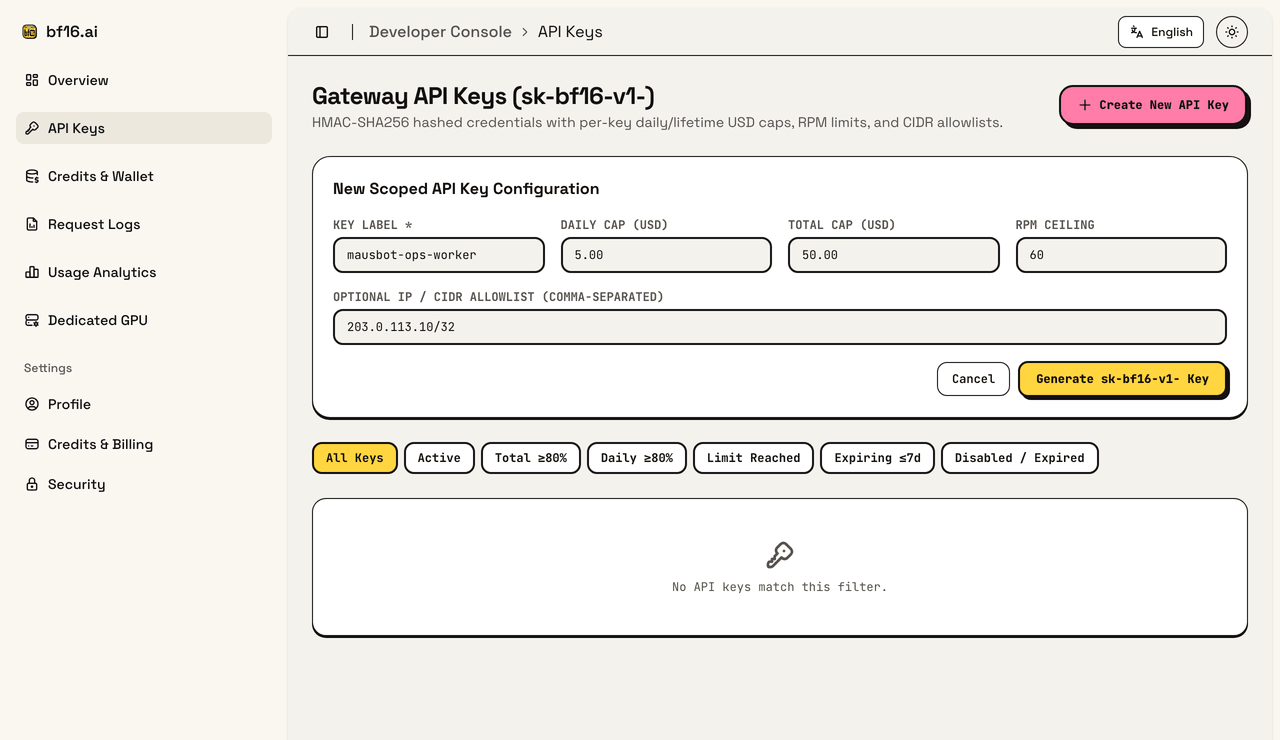
▲ Real Console View (bf16.ai/dashboard/keys): Provisioning a dedicated sk-bf16-v1- key for mausbot-ops-worker with a $5.00 daily USD cap, $50.00 lifetime ceiling, 60 RPM limit, and IP CIDR lock.
4. 30-Step Run Economics at Official-Parity Prices
A common misconception among developers evaluating uncensored or abliterated endpoints is assuming they must pay a 3x "specialty markup" or tolerate sluggish hobbyist GPUs. bf16.ai benchmarks retail rates directly against official vendor API pricing — matching DeepSeek Official Standard ($0.30 / $1.20) on deepseek/deepseek-v4.1-flash-abliterated and undercutting Z.ai Official FlashX ($0.37 / $1.25) on multimodal zai-org/glm-5.3-flash-abliterated ($0.24 / $1.00).
More importantly, multi-step agents resend growing conversation histories and tool schemas on every turn. Because bf16.ai automatically discounts cached prefix hits to $0.05–$0.06 / 1M tokens, a 30-step MausBot run consuming 100,000 cumulative input tokens (88% cached prefix) and 1,200 tool-call output tokens costs less than one cent ($0.0094):
| Model ID on bf16.ai | Modality | Context | Input / Cached / Output (per 1M) | Best MausBot Role |
|---|---|---|---|---|
deepseek/deepseek-v4.1-flash-abliterated | Text + Tools | 1M | $0.30 / $0.05 / $1.20 | High-frequency 30–50 step CLI, DOM & ETL workers |
zai-org/glm-5.3-flash-abliterated | Vision + Text | 1M | $0.24 / $0.06 / $1.00 | Visual browser QA, screenshot modals & OCR forms |
zai-org/glm-5.3-abliterated | Text + Tools | 1M | $1.40 / $0.30 / $4.40 | Supervisor planning, complex code diffs & SAST |
5. Production Hardening Checklist: Four Honest Caveats Before You Unleash 10 Bots
Low-refusal models behave like senior Unix command-line utilities: they execute exactly what your pipeline asks without second-guessing your motives. Before running ten MausBot employees overnight, enforce these four engineering guardrails:
- One Bot = One Scoped
sk-bf16-v1-Key with a Daily USD Cap: Because an abliterated model will not stop mid-run to lecture you, an infinitewhile(true)retry bug in your own script will happily keep executing untilmax_stepsor your budget cap fires. Always set a$5.00or$10.00Daily Cap onbf16.ai/dashboard/keys. - Enforce Security in Deterministic Code, Never RLHF Politeness: Never rely on an LLM's refusal training as an access-control layer. Restrict writable directories, outbound domains, and destructive verbs (
DROP,rm -rf, live wire transfers) inside MausBot's[sandbox]policy. - Keep
temperature <= 0.2for Tool-Heavy Loops: At30+steps, high sampling temperatures introduce drift in CSS selectors and JSON argument types. Keeptemperaturebetween0.1and0.2for worker bots, reserving higher temperatures (0.6+) strictly for creative copywriting agents. - Tier Flash vs. Flagship Deliberately: Use
deepseek/deepseek-v4.1-flash-abliteratedfor 90% of step-by-step execution loops so tool wait times stay sub-second, and escalate only ambiguous architectural or root-cause synthesis steps tozai-org/glm-5.3-abliterated.